

Armillary Spheres: the Timeless Charm of Celestial Mechanics in Your Garden
It is hard to say what is most captivating about these newly ancient instruments—the sheer complexity of the sphere itself, or rather the history that has accompanied the development of our understanding of the heavens. What is certain is that, wherever they are placed, armillary spheres attract curiosity far more powerfully than an ordinary sculpture. But what exactly are armillary spheres, and what do they represent? And most importantly, what are they for? Let us retrace the history of these ancestral objects and discover it together in this article.
What Is an Armillary Sphere and What Is It Used For?
Until the invention of the telescope, the armillary sphere was an essential instrument used by astronomers to study the position and motion of celestial bodies. Over time, this instrument—once used to measure the sky—became a representation of the celestial vault itself and, thanks to its history and complexity, a symbol of knowledge.
Today, no longer used as astronomical tools but mostly as timekeepers, armillary spheres are crafted and chosen to display, through their intricate details, the fascinating mathematical precision of celestial mechanics. Their value goes far beyond mere decorative impact: anyone who observes them is naturally drawn into a dynamic artwork that changes with the light, interacts with the Sun and, by playing with shadows, reveals the infinite sky within a small instrument.

Installing a sculpture in a garden profoundly influences the atmosphere of the outdoor space and says much about the taste of the person who envisioned, desired and created it.
Choosing a custom-made armillary sphere to enhance your garden, courtyard or patio means personalising your space with a unique artwork that uses the thread of time to celebrate past and present, art and science, mathematics and philosophy.
Furnishing a garden with an armillary sphere inevitably lends a timeless character to the space, where mathematical precision creates a captivating interplay between art and nature, telling a story, engaging in dialogue with the viewer and evoking emotion.

These works can also be used in settings that are not strictly private. For example, an armillary sphere may be placed at the entrance of a home to welcome guests with this unique and exclusive artwork that immediately expresses the identity of its owners. Or it may even be installed in a business setting to lend prestige to a representative space that reflects the values and aspirations of a company.

Why Choose a Bespoke Armillary Sphere
Armillary spheres are often sold as mass-produced items designed to be adjusted, via a joint, to the latitude of their final installation site.
Commissioning an armillary sphere for your outdoor space means refusing a one-size-fits-all object and instead desiring a work created expressly for you, for your location and according to your personal taste. Such a piece is also far more solid and stable, maintaining its structure unchanged over time.
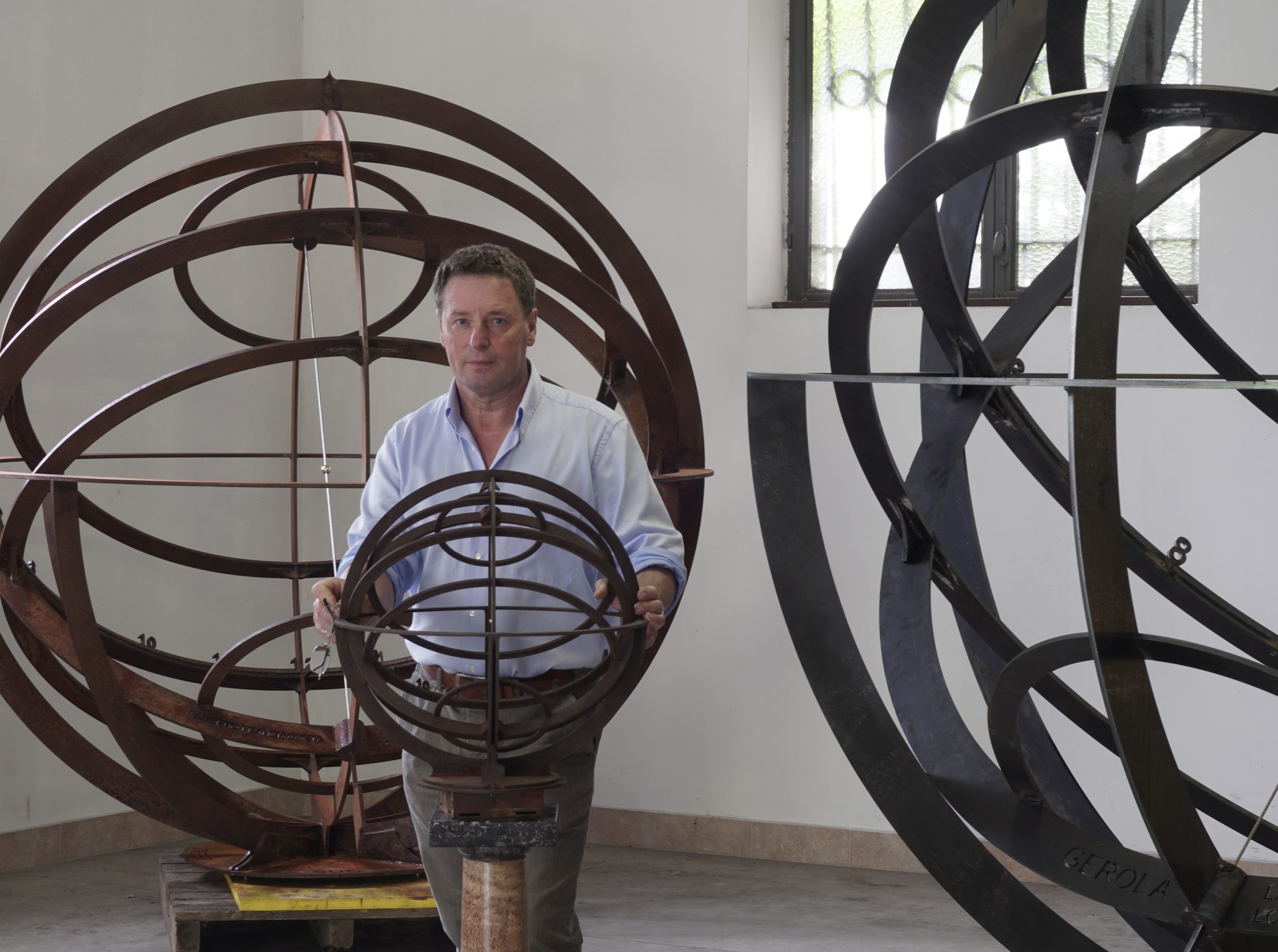
The armillary spheres I create are designed from the outset for the precise geographical coordinates provided by the client, ensuring maximum solidity, stability and accuracy. Their rings are not made from bent metal profiles but cut from metal plates using CNC machines, following the specific design of each piece.
This distinctive feature makes it possible to create a new artwork every time, customisable not only for the client’s geographical coordinates but also in materials, finishes, mountings, dimensions, complexity, numbering, inscriptions or commemorative phrases—fulfilling the desires of the person who imagined and commissioned it to enhance their garden or space.
How to Choose the Right Armillary Sphere for Your Garden
Armillary spheres integrate beautifully into any type of garden—formal, classical, modern, minimalist or rustic—also depending on the material used to make them.
Weathered corten steel is ideal for both rustic and contemporary gardens, yet it can also blend harmoniously into classic settings. The complexity of the sphere can be diminished or augmented as desired. Polished stainless steel is perfect for prestigious or representative locations, although its reflections can be striking in any garden. Bronze, the metal traditionally used in sculptures, is exceptionally fitting for classical gardens.
All the metals used—bronze, corten steel and stainless steel—are chosen specifically to guarantee maximum durability even in constant outdoor exposure, ensuring they can last and be passed down for generations. They require no maintenance: since they are instruments dedicated to the passage of time, it is almost natural—and perhaps preferable—to let time leave its mark, creating an elegant, timeless patina that enhances their value. However, if cleaning is desired, a little warm water is all that is needed.

Where to Place an Armillary Sphere
Armillary spheres, typically installed on pedestals or columns, can be used in countless settings: at the centre of a labyrinth, to symbolise the journey towards knowledge; in the middle of a well-kept lawn as a focal point that breaks the monotony of an open space; along a pathway, nestled among border plants; at the end of a walkway as a visual guide; on the water’s edge of a small pond so that they appear to float; in front of a bench; in a niche; in the centre of a courtyard; on the stone balustrade of a terrace; at the entrance of a home; in front of representative buildings, and so on.
They are often placed in the sunniest areas so that they can be admired while functioning as sundials. Yet they are equally suitable for small, intimate gardens—sometimes shaded—that invite contemplation. What matters is that when illuminated by the Sun, they are correctly oriented and show the accurate time.