

Garden Sundials and Beyond: How Most of These Instruments Work and How to Read Them – for Gardening Enthusiasts and More
Sundials are instruments capable of indicating the time with an accuracy of up to one minute.
But why does the time shown by sundials, with only a few exceptions, not coincide with that indicated by ordinary clocks? Essentially, this happens because sundials, again with few exceptions, show the true solar time of the place where they are installed.
The clocks we use in everyday life, instead, all display time zone time: an arbitrarily established convention designed to unify the time of several countries to facilitate human activities – for example transport and telecommunications. Wintertime is commonly referred to as “solar time” because it is the closest approximation to true solar time, especially when compared with summer daylight saving time.
To compare the true solar time indicated by sundials with the time kept within a time zone, two distinct corrections must be applied to the sundial reading: the mean time correction and the longitude correction. To understand why these differences arise, we must first understand the operating principles of sundials.

How a Sundial Works: Basic Principles and How to Read the Time
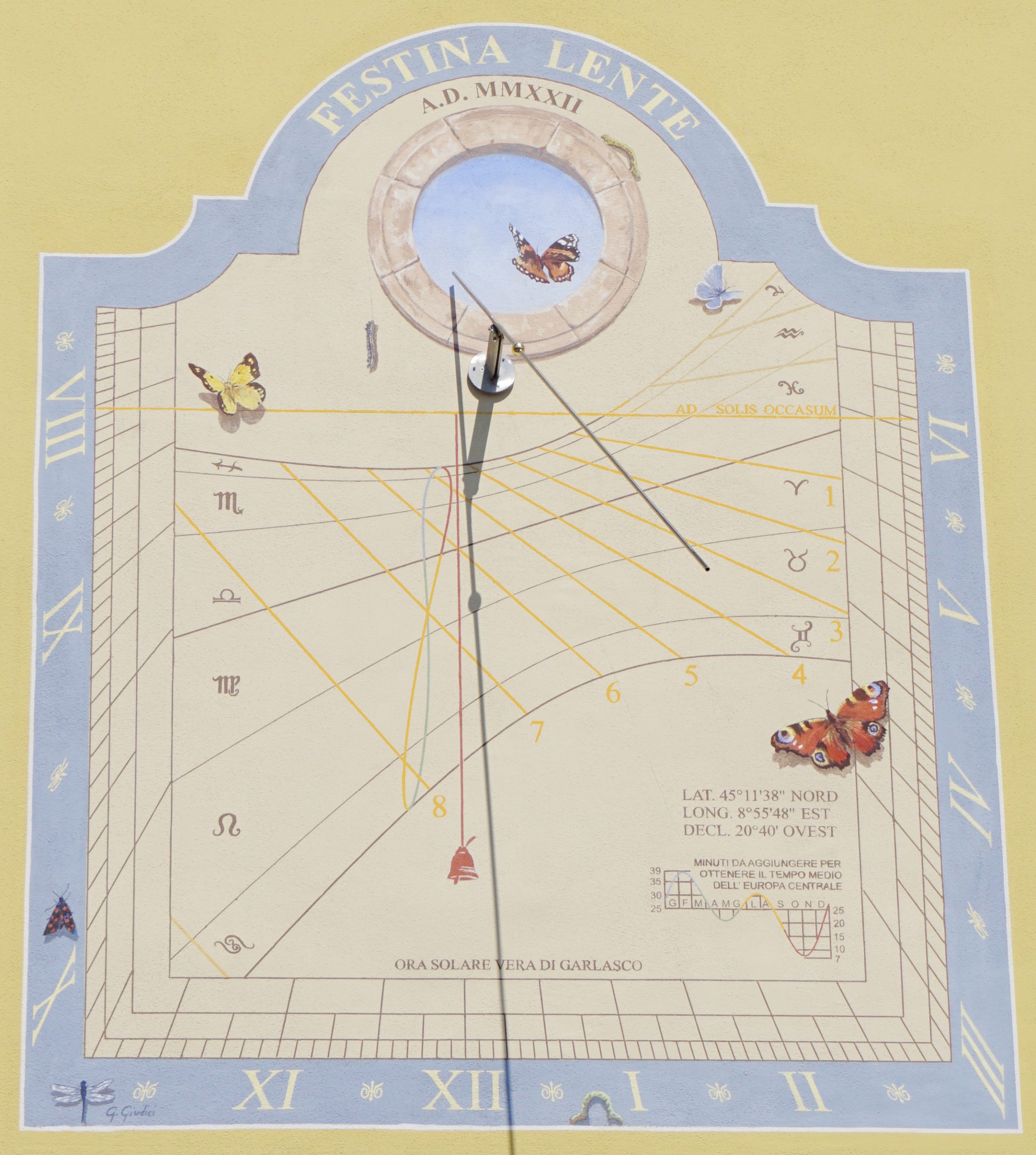
A sundial is essentially a dial – whose shape and size may vary – accurately marked and equipped with an element called a gnomon, used to cast a shadow onto the dial. The gnomon itself may take different forms and dimensions depending on the type of sundial being constructed. The shadow cast by the gnomon moves in the opposite direction to the apparent motion of the Sun.


The principle by which the hour lines are laid out is based on the rotation of the Earth, which brings the Sun to cross the local meridian every 24 hours. Dividing the full 360° rotation on the equatorial plane by 24 hours results in 15° per hour, and 4 minutes for every 1°.
The same principle can be applied at any point on the Earth’s surface, provided the gnomon is always set parallel to the Earth’s axis and ignoring parallax error which, given the astronomical distances involved, is negligible for the accuracy required by these instruments.
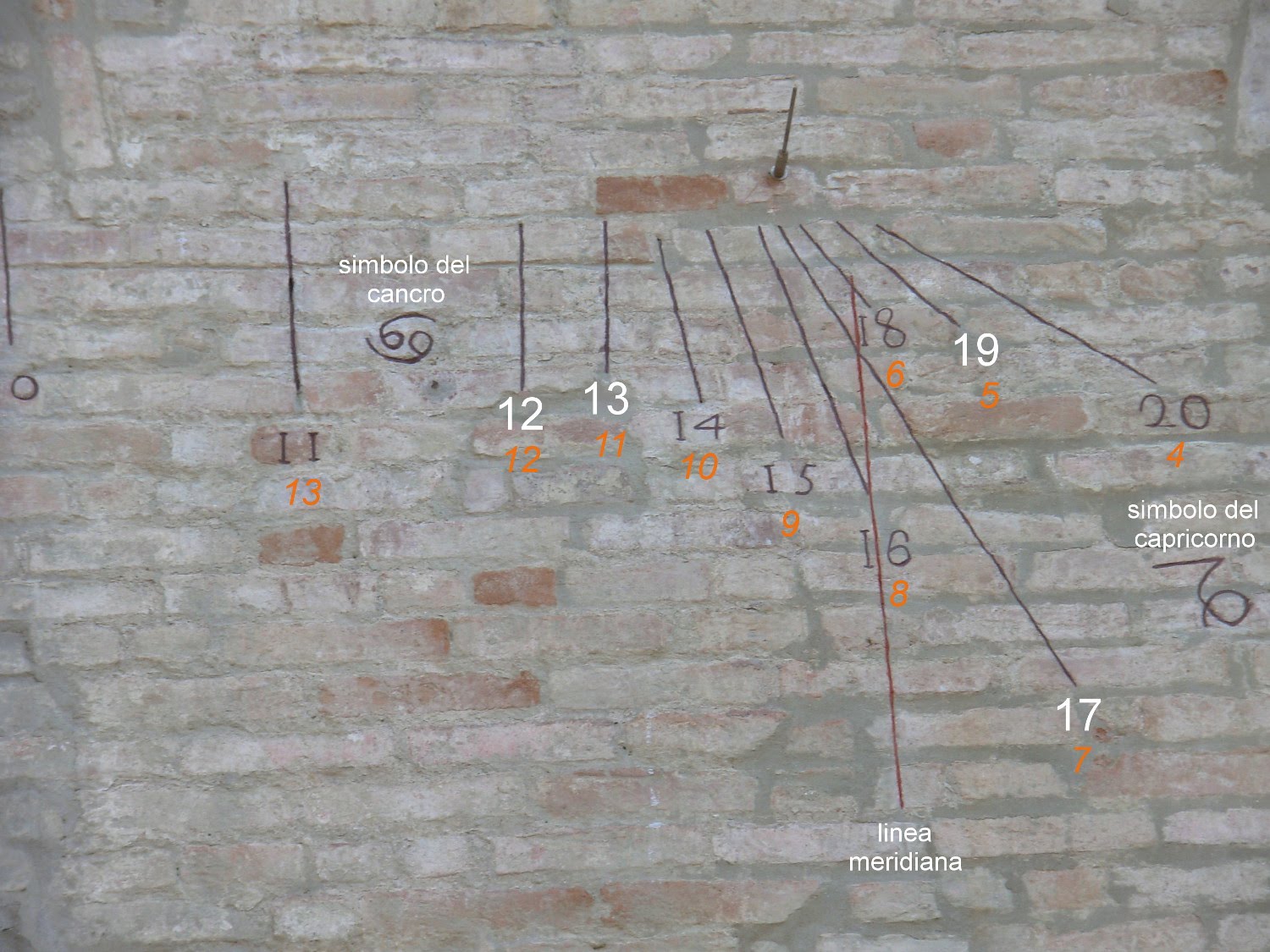
Naturally, the hour lines on sundials constructed at different latitudes – whether horizontal, vertical or inclined – are no longer spaced 15° apart, but become deformed according to the angle at which the dial intersects the gnomon aligned with the Earth’s axis of rotation.


The Sun, in its apparent daily motion, describes an arc from east to west, passing southwards and reaching its highest point of the day when it crosses the local meridian on which the sundial is installed. This apparent arc is never identical from one day to the next: between the winter solstice and the summer solstice it gradually rises, while from the summer solstice to the winter solstice it gradually descends. In the ten days surrounding the solstices, however, this change becomes so slight as to be imperceptible without appropriate instruments. The Sun appears almost still, and it is precisely this apparent “standstill” that gives rise to the term solstice.


The Sun’s varying height in the sky is used to trace calendars on sundial dials. Typically, these calendars follow the signs of the zodiac; more rarely, they show civil calendars. However, the same principle can be used to draw personalised lines marking birthdays, anniversaries and other commemorative dates.


Since the Sun follows the same apparent arc twice a year—once while rising and once while descending—the dials display double indications. The only possible ambiguity is resolved simply by knowing the season in which the observation is made.

In practice, the gnomon’s shadow moves across the dial like the hand of a conventional clock: its angle indicates the hour of the day, and its length reveals the month and date. Alternatively, we may think of it as the shadow of a finger tracing the diagram on the dial, showing us the day, the hour and the Sun’s position in the sky.
Correction for Mean Time and New Conventions for Measuring Time
For centuries, timekeeping remained unchanged, based exclusively on the Sun, regarded as a precise and indispensable reference. Everything changed around 1650: in the seventeenth century, with the advent of more reliable mechanical clocks, it became clear that the solar day does not always last exactly twenty-four hours. Depending on the season, it can vary daily by a few seconds, and at certain times of the year the Sun’s passage across the local meridian may occur more than 20 seconds earlier or later than the exact twenty-four-hour mark.
To understand the cause of these variations, we must remember that the Earth not only rotates on its axis, but also orbits the Sun at a speed of approximately one degree per day (since it covers 360 degrees in about 365 days). Consequently, for the Sun to cross the same meridian again on the following day, the Earth must rotate 361 degrees on its axis (360 degrees plus one) to compensate for the degree lost in its daily revolution around the Sun.


Unfortunately, the Earth follows an elliptical orbit around the Sun, which occupies one of the foci of this ellipse, and the complex gravitational forces acting upon it (which we will not discuss in detail here for the sake of simplicity) cause it to travel along its orbit at varying speeds depending on its position. A change in orbital speed affects the angular distance covered in the approximate daily degree of revolution. Indeed, when the orbital motion is faster, the Earth travels slightly more than one degree and must rotate correspondingly further on its axis for the Sun to cross the same meridian, inevitably causing the Sun to transit the meridian later. Consequently, all the hours of that day will also be “late” compared with the previous day. Conversely, if the Earth is in a slower section of its orbit, it covers less than the approximate daily degree and the Sun crosses the meridian earlier. Even tiny fractions of a degree produce noticeable differences from one day to the next, which, when accumulated over time, result in systematic oscillations—depending on the season—of approximately 14 minutes in advance and 16 minutes in delay. In practice, the Sun’s meridian passage, and therefore all the hours it defines, are subject to regular cyclical fluctuations.
To avoid the inconvenience of having to synchronise mechanical clocks with the real Sun every day, it was decided to adopt “mean time”: a reference based on a virtual Sun which, by convention, moves at a perfectly constant rate throughout the year, thereby cancelling out the fluctuations in the true solar day. The difference between true solar time and the mean time indicated by mechanical clocks became known as the Equation of Time.


This effect of mean time can be easily observed by comparing the Sun’s passages across the local meridian, since the other astronomical events related to our star—such as sunrise and sunset—are naturally subject to seasonal variations.
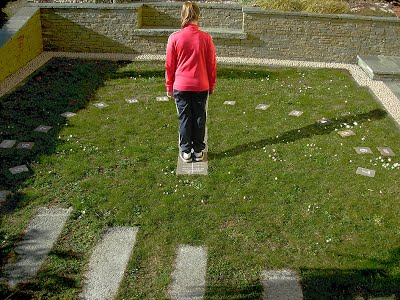
If we point a camera due south and take a photograph at precisely mean noon (as indicated by an ordinary clock) on several consecutive days, then superimpose the images, we can observe the advance and delay of mean noon relative to true solar noon, represented by the meridian line. If we continue this process throughout the entire year, the resulting figure resembles an elongated figure-of-eight.


In some well-crafted sundials, and in true meridian lines, the advance or delay of the virtual Sun for each noon of the year was often indicated along the line of true local noon. This was made possible through the depiction of the so-called lemniscate, formed by two overlapping curves. To interpret it correctly, the line needed to be drawn in such a way that each section of the figure corresponded clearly to the different months or seasons.

The difference between mean solar time—kept by ordinary clocks—and true solar time—traditionally shown by sundials—is called the Equation of Time. These values are usually displayed in a specific table placed on or near the dial, and represented in a chart. In this chart, a horizontal line represents the twelve months of the year, while the perpendicular columns indicate the minutes to be added to or subtracted from the time shown by the sundial, depending on the date of observation.

The Adoption of Time Zones Added Another Gap Between Local Solar Time and Civil Time
Local mean time, like true local time, is strictly tied to the meridian of the place in question. It is identical for all locations lying on the same meridian but changes with longitude. For example, each degree of longitude corresponds to a chronometrically measurable difference of four minutes, meaning that, historically, a single country could have dozens of different local times simultaneously. Towards the end of the nineteenth century, with the development of railways and telecommunications, most nations recognised the need to regulate time on a scale wider than that of each town or village, and thus adopted the system of time zones. This convention involved dividing the world into twenty-four one-hour sectors, based on meridians spaced 15 degrees apart, starting from the Greenwich Prime Meridian at 0°. In principle, all territories crossed by a given reference meridian adopted the local mean time of that meridian.
How to Read a Sundial Today: Time Zones and Mean Time
Apart from sundials built exactly on the reference meridian for the time zone in use, all other sundials—designed to display true local solar time—require a correction in order to be compared with civil time. It is necessary to add or subtract four minutes for each degree of difference from the reference meridian: if the sundial lies to the east, four minutes per degree are subtracted; if it lies to the west, they are added. This is a constant correction throughout the year and is linked to longitude. For a correct modern reading, this correction must be combined with the mean-time correction, adding or subtracting the minutes corresponding to the date of observation. To simplify the reading of modern sundials, the constant longitude correction is usually incorporated directly into the mean-time chart, placed next to or superimposed on the dial.


Dials Designed to Indicate Time-Zone Time Directly
In some modern dials featuring a lemniscate, the longitude correction can be incorporated into the design of the diagram itself, so that the shadow falling on the figure indicates the time-zone’s time directly.

The Most Recent Adjustment to Local Solar Time
Wintertime is often—albeit incorrectly—referred to as “solar time” because it is the closest approximation to true solar time, especially when compared with summer daylight-saving time.
Beginning in the twentieth century, many countries introduced and adopted daylight-saving time to make better use of the increased daylight available in summer, adding yet another correction to those described above. Although some sundials include a double scale—one for winter and one for summer—this is a relatively minor issue. Generally, anyone familiar with sundials knows that during the summer period, daylight-saving time must be applied by simply adding one hour to the time indicated by the sundial, following any previous corrections.